
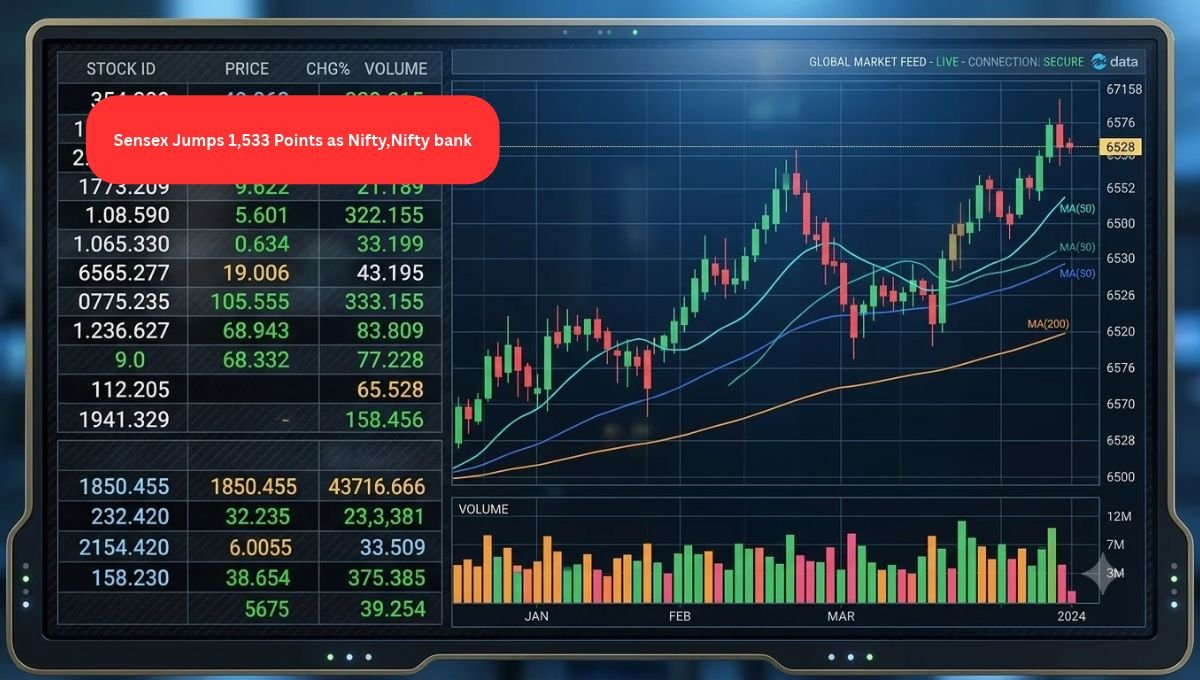
Stock Market Today, October 15, 2026: Indian equity markets continued their upward momentum for the third consecutive trading session on Thursday. The BSE Sensex jumped more than 1,500 points, while the Nifty 50, nifty bank approached the crucial 23,000 level, supported by positive corporate earnings, improving investor sentiment, and favourable currency movements.
Despite weakness across several Asian markets, Indian benchmark indices maintained their strong performance amid global uncertainty surrounding artificial intelligence stocks, US inflation, and expectations of another interest rate hike by the US Federal Reserve.
Sensex and Nifty,nifty bank Closing Today: Key Market Highlights
The domestic stock market ended Thursday’s session with substantial gains, extending its three-day winning streak.
The Sensex closed at 74,315, gaining 1,533 points from its previous closing level. Meanwhile, the NSE Nifty 50 advanced 374.65 points, or approximately 1.6%, to settle at 22,997.
Indian Stock Market Performance – October 15, 2026
| Market Indicator | Closing Value | Change |
|---|---|---|
| BSE Sensex | 74,315 | +1,533 points |
| NSE Nifty 50 | 22,997 | +374.65 points |
| Nifty Percentage Change | — | +1.6% |
| USD/INR | ₹95.50 | Rupee gained 0.1% |
| Dollar Index | 102.10 | -0.4% |
| Brent Crude Oil | $103.78/barrel | -2% |
Figures are based on the market information provided for October 15, 2026. Currency and commodity values reflect the reported trading period.
Why Did the Indian Stock Market Rise Today?
Several domestic and international factors contributed to Thursday’s stock market rally.
1. Positive Corporate Earnings Boost Investor Confidence
Encouraging quarterly results, particularly from banking companies, helped strengthen market sentiment.
Investors responded positively to the earnings performance of major domestic businesses, supporting buying activity across benchmark indices.
According to V. K. Vijayakumar, Chief Investment Strategist at Geojit Investments, positive corporate earnings and changing global investment trends have provided support to Indian equities.
2. Indian Markets Outperform Other Asian Indices
While several Asian markets faced selling pressure, Indian equities managed to maintain their upward trajectory.
Global investors remained cautious about valuations in artificial intelligence-related stocks, persistent US inflation, and uncertainty surrounding the Federal Reserve’s monetary policy.
However, these developments did not prevent Indian benchmark indices from extending their gains.
3. Weaker US Dollar Supports Market Sentiment
The US Dollar Index declined 0.4% to 102.10, providing some relief to emerging-market currencies.
A weaker dollar can improve sentiment toward emerging-market assets, although actual investment flows depend on several economic and financial factors.
Indian Rupee Strengthens for Fourth Consecutive Session
Alongside the stock market rally, the Indian rupee recorded gains for the fourth consecutive trading session.
The domestic currency closed at approximately ₹95.50 against the US dollar, strengthening by 0.1%.
According to the reported figures, the rupee has appreciated nearly 2% during the week.
The currency’s recovery was supported by a combination of factors, including:
- Measures taken by the Reserve Bank of India (RBI).
- Weakness in the US Dollar Index.
- Declining international crude oil prices.
- Changing expectations surrounding US monetary policy.
However, currency market participants continue to monitor importer demand for dollars, foreign portfolio investment flows, and global energy prices.
Brent Crude Falls 2%, But Oil Prices Remain Above $100
International crude oil prices also declined during Thursday’s trading session.
Benchmark Brent crude traded around $103.78 per barrel, representing a decline of approximately 2% compared with its previous close.
The fall followed expectations that global oil supplies could improve if the United States eased restrictions affecting certain tanker operations.
For India, lower crude oil prices are generally favourable because the country depends heavily on imported petroleum.
A sustained reduction in energy prices can help ease import costs and inflationary pressure.
However, crude oil remaining above $100 per barrel continues to present a challenge for the domestic economy and financial markets.
Iran-US Conflict Remains a Key Risk for Investors
Despite the recent recovery in benchmark indices, market analysts remain cautious about the sustainability of the rally.
Uncertainty surrounding the Iran-US conflict and elevated crude oil prices could create fresh volatility in the coming sessions.
If geopolitical tensions continue and energy prices remain high, the Indian economy may face additional pressure through higher import costs and inflation risks.
Therefore, investors will closely monitor developments in the Middle East alongside domestic corporate earnings and global monetary policy decisions.
Could Foreign Investment Inflows Support the Rupee Further?
Anil Kumar Bhansali, Head of Treasury at Finrex Treasury Advisors LLP, highlighted several important factors that could influence the rupee in the near term.
These include RBI intervention, demand for dollars from importers, foreign portfolio investment flows, and international crude oil prices.
He also pointed to potential foreign currency inflows associated with the anticipated Jio IPO and the Fairfax transaction.
According to the expectations cited in the report, the Fairfax deal could bring approximately $6–7 billion in inflows.
Such developments could provide additional support to the domestic currency, although the actual impact would depend on the timing and size of the transactions.
The commentary also indicated a possible rupee movement toward the ₹94–₹94.50 range against the US dollar.
This represents an analyst expectation rather than a guaranteed currency target.
What Should Stock Market Investors Watch Next?
Following the three-day rally, investors are likely to focus on several important developments that could determine the market’s next direction.
| Key Factor | Why It Matters |
|---|---|
| Corporate Earnings | Strong quarterly results may support investor confidence |
| US Federal Reserve | Interest rate decisions can influence global capital flows |
| Brent Crude Prices | Higher oil prices may increase India’s import costs |
| Iran-US Conflict | Geopolitical uncertainty could trigger market volatility |
| Rupee Movement | Currency fluctuations influence import costs and foreign investment |
| Foreign Investment Flows | Higher inflows may support domestic financial markets |
| RBI Measures | Central bank actions can influence currency market stability |
Conclusion
The Indian stock market delivered another strong performance on October 15, 2026, with the Sensex gaining 1,533 points and the Nifty 50 , nifty bank closing near the 23,000 milestone.
Positive corporate earnings, a weaker US dollar, falling crude oil prices, and improving currency sentiment contributed to the three-day rally.
However, investors should remain cautious as geopolitical tensions, elevated energy prices, and uncertainty surrounding US interest rates continue to influence global markets.
The sustainability of the current rally will largely depend on corporate earnings, foreign investment flows, and developments in the international economic environment.
Disclaimer: This article is published for informational and educational purposes only. It does not constitute financial or investment advice. Stock market investments are subject to market risks. Consult a SEBI-registered investment adviser before making investment decisions.

 By
By