
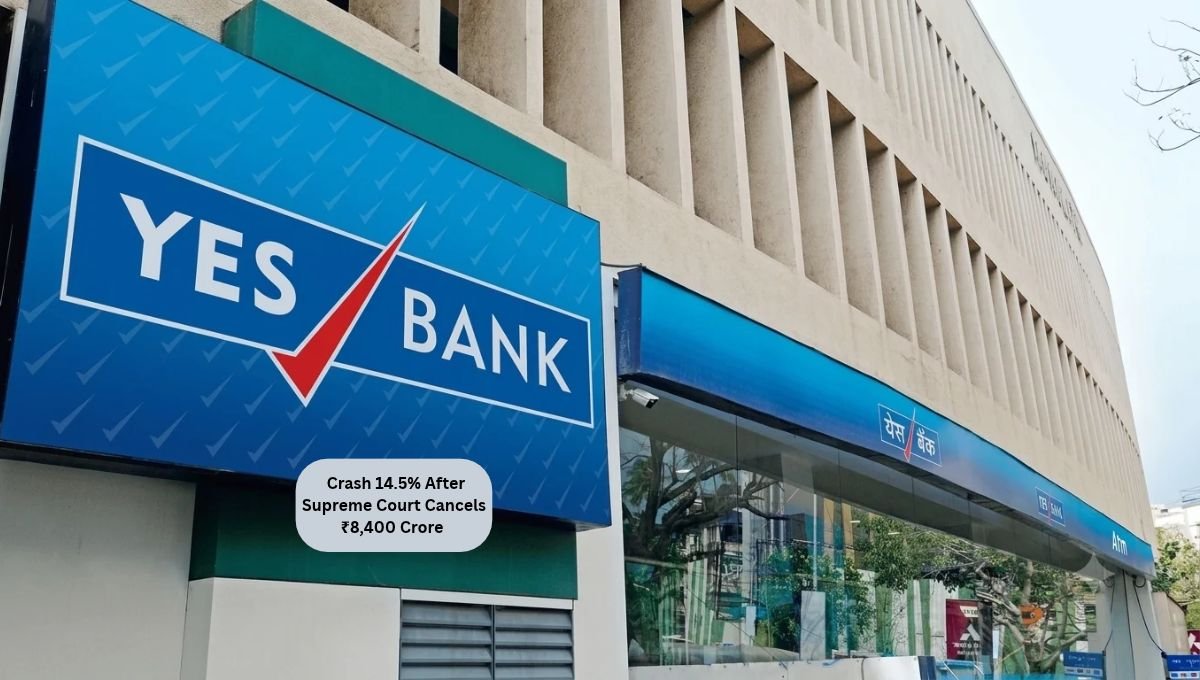
 Yes Bank News Today: India’s Supreme Court has delivered a major ruling against Yes Bank, setting aside the lender’s decision to write off Additional Tier-1 (AT1) bonds worth Rs 8,400 crore during its 2020 restructuring. The judgment provides significant relief to bondholders who have been fighting a legal battle for several years.
The decision also dismisses appeals filed by Yes Bank, the Reserve Bank of India (RBI), and the central government against the Bombay High Court’s 2023 ruling.
Following the announcement, Yes Bank shares declined by as much as 14.5%, reflecting investor concerns about the potential financial impact on the lender.
Key Highlights
- Supreme Court sets aside Yes Bank’s Rs 8,400 crore AT1 bond write-off.
- Appeals filed by Yes Bank, RBI, and the government have been dismissed.
- The judgment upholds the Bombay High Court’s 2023 decision.
- Yes Bank shares dropped as much as 14.5% following the ruling.
- Restoration of the bonds could affect the bank’s profitability and capital adequacy.
- Retail and institutional bondholders stand to benefit from the decision.
Why Did the Supreme Court Cancel Yes Bank’s AT1 Bond Write-Off?
The dispute dates back to March 2020, when Yes Bank faced a severe financial crisis and underwent a restructuring process.
As part of the rescue arrangement, new investors were brought into the bank, while AT1 bonds worth approximately Rs 8,400 crore were completely written off.
However, equity shareholders faced a different treatment. Under the restructuring scheme, 75% of their shares were subject to a three-year lock-in period.
This difference in treatment became a major point of contention among bondholders, who subsequently challenged the write-off in court.
In January 2023, the Bombay High Court ruled in favour of the bondholders and set aside the write-off.
Yes Bank, the RBI, and the central government challenged that judgment before the Supreme Court. However, on October 15, 2026, the apex court upheld the earlier decision.
What Did the Supreme Court Say?
According to the judgment described in the Reuters report, the bank’s administrator incorrectly assumed that he retained the authority to write down the AT1 bonds even after the restructuring scheme had been finalised.
The Supreme Court found that the final reconstruction scheme did not contain the provision permitting the write-down of these bonds.
Consequently, the administrator’s decision to extinguish the securities was held to be impermissible.
The judgment represents an important development in the interpretation of bank restructuring powers and the treatment of investors holding high-risk debt instruments.
What Are AT1 Bonds, and Why Are They Risky?
Additional Tier-1 bonds are financial instruments issued by banks to strengthen their regulatory capital.
These securities generally offer higher returns than conventional debt instruments, but they also carry additional risks.
During periods of severe financial stress, AT1 bonds may be written down or converted into equity when the applicable regulatory and contractual conditions are satisfied.
Unlike ordinary fixed deposits, these instruments do not provide guaranteed repayment of the invested principal.
Yes Bank AT1 Bond Case: Important Figures
| Particulars | Details |
|---|---|
| Bank | Yes Bank |
| Original AT1 bond write-off | Rs 8,400 crore |
| Year of restructuring | 2020 |
| Bombay High Court ruling | January 2023 |
| Supreme Court judgment | October 15, 2026 |
| Appeals dismissed | Yes Bank, RBI and central government |
| Maximum reported share-price decline | 14.5% |
| Major strategic investor | Sumitomo Mitsui Banking Corporation |
| Potential impact | Profitability and capital adequacy |
Supreme Court Raises Concerns Over Sale of AT1 Bonds to Retail Investors
Another significant aspect of the judgment concerns the way Yes Bank sold its AT1 bonds to individual investors.
The Supreme Court observed that the bank had offered these high-risk securities to retail investors in violation of applicable RBI restrictions.
According to the court, the regulatory framework restricted the sale of these instruments to eligible institutional investors, including mutual funds and insurance companies.
Despite these restrictions, Yes Bank actively offered the securities to individuals.
The court also indicated that greater scrutiny should have been exercised before exposing individual investors to such complex and risky financial products.
These observations could have wider implications for investor protection and the distribution of sophisticated banking instruments.
Supreme Court Questions RBI’s Oversight During Yes Bank Crisis
The judgment also raised concerns about regulatory supervision during the period leading up to Yes Bank’s financial collapse.
According to the court, the lender’s core equity capital ratio had fallen to just 0.6% by the end of 2019, significantly below the required level of 7.375%.
The court criticised the RBI’s supervisory role during the deterioration in the bank’s financial position.
These observations highlight the importance of timely regulatory intervention, particularly when a financial institution experiences a rapid decline in its capital strength.
Yes Bank Share Price Falls 14.5% After Supreme Court Judgment
Yes Bank shares came under heavy selling pressure following the Supreme Court’s decision.
The stock declined by as much as 14.5% during the trading session as investors assessed the possible consequences of restoring the previously written-off AT1 bonds.
In a stock exchange filing, Yes Bank stated that it was obtaining and examining the final judgment.
The bank’s subsequent disclosures will be important in determining the precise financial implications of the ruling.
How Could the Judgment Affect Yes Bank’s Financial Position?
Restoring the AT1 bonds could create additional financial obligations for Yes Bank.
According to the Reuters report, the restoration would result in a one-time impact on the bank’s profit and loss account and reduce its capital adequacy ratio.
Capital adequacy is an important indicator of a bank’s ability to absorb financial losses while continuing its operations.
A reduction in this ratio could therefore attract attention from regulators, investors, and market analysts.
Vivek Ramji Iyer, a partner and national leader for financial services risk advisory at Grant Thornton, also highlighted the possibility of increased regulatory uncertainty affecting investor sentiment.
However, the exact accounting treatment and financial impact will depend on the implementation of the judgment and subsequent regulatory disclosures.
What Does the Ruling Mean for Yes Bank AT1 Bondholders?
For investors who lost their money during the 2020 write-off, the Supreme Court judgment represents a significant legal victory.
Retail bondholders had argued that the securities were improperly sold and that the administrator lacked the authority to extinguish them after the reconstruction scheme was finalised.
The judgment strengthens their position and opens the way for further steps towards restoring their investments.
However, investors should distinguish between the court setting aside the write-off and the actual receipt of money. The process and timing of implementation will require further clarity.
Institutional Investors May Also Benefit
Apart from individual bondholders, institutional investors holding Yes Bank’s AT1 securities also stand to benefit.
These include Kotak Mahindra Mutual Fund and Nippon India Asset Management.
Following the judgment, both fund houses temporarily suspended subscriptions to certain affected schemes.
The decision was linked to concerns that restoration of the bonds could cause a sudden increase in the schemes’ net asset values (NAVs), potentially affecting investors entering at that stage.
Sumitomo Mitsui Banking Corporation’s Stake in Yes Bank
The Supreme Court ruling comes after Japan’s Sumitomo Mitsui Banking Corporation (SMBC) acquired a significant stake in Yes Bank.
The Japanese banking group purchased a 24.99% stake in the Mumbai-based lender in 2025, becoming an important strategic investor.
The latest judgment adds another development for market participants monitoring Yes Bank’s financial performance, capital position, and long-term restructuring journey.
What Should Yes Bank Investors Watch Next?
Following the Supreme Court judgment, several developments could influence investor sentiment.
| Key Development | Why It Matters |
|---|---|
| Final judgment assessment | Clarifies the bank’s obligations |
| AT1 bond restoration | Determines treatment of affected securities |
| Profit and loss impact | Could affect reported earnings |
| Capital adequacy ratio | Important for financial stability |
| RBI’s response | May provide regulatory clarity |
| Stock exchange disclosures | Updates shareholders on developments |
| Mutual fund NAV adjustments | Could affect schemes holding the bonds |
Investors should closely monitor official announcements rather than make decisions based solely on short-term share-price movements.
Conclusion
The Supreme Court’s decision to set aside Yes Bank’s Rs 8,400 crore AT1 bond write-off marks a major development in one of India’s most closely watched banking disputes.
While the judgment provides relief to bondholders, it also creates potential financial and regulatory challenges for Yes Bank.
The lender’s next disclosures, the implementation of the court’s directions, and the treatment of the restored securities will be important factors to watch in the coming weeks.
Disclaimer: This article is intended for informational purposes only and should not be considered investment advice. Investments in stocks, bonds, and mutual funds involve market risks. Consult a SEBI-registered investment adviser before making financial decisions.
Read More:Jio Credit to Receive Rs 18,268 Crore Investment;…
 By
By